Flex duct installation looks like the easiest part of the job, and that is exactly why it gets done wrong. Most bad flex I’ve seen comes down to three things: kinks, sags and runs that are too long. All three are avoidable.
I worked the tinner trade for about four years, and I’ve been in construction more than twenty years. These days I manage projects for a general contractor, and I still look up into ceilings and complain about other people’s flex, and have them fix it.
Where flex duct installation is the right call
In a house, insulated flex duct is normal in the attic. Bath exhaust fans can run in flex, and dryer vents often do too, though either vent can also be hard pipe. On commercial projects, they most likely will be hard pipe with a minimal flex duct connection.
On commercial work, flex is usually the last piece of a round run on a supply and return run. The round pipe comes off the take-off, and a short piece of flex connects it to the register or grille in a concealed ceiling, above the tile or hard lid.
Where flex duct does not belong
Flex is not used in exposed ceilings. If people can see the duct, it’s hard pipe.
Some designs call for hard pipe all the way to every register and grille. If the drawings say that, flex is not an option, no matter how much faster it would go.
How long can a flex duct run be?
Short. On commercial work the max limits come from the SMACNA standards and the install detail on the drawings. The detail on the job sets the number, and it changes from project to project. The one on a recent job of mine capped insulated flex at 4 feet. The rule I work to is to keep it short, with one gradual bend of 90 degrees or less. U-shaped bends are not allowed.
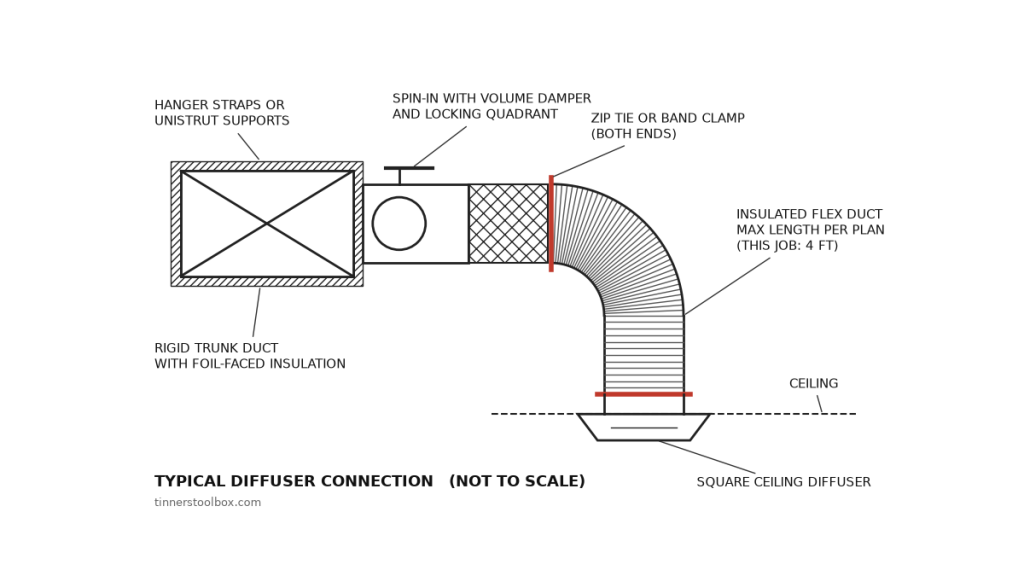
A well-prepared commercial set usually has a standard detail showing the minimums and maximums: how many bends, how sharp a bend can be, support spacing and max length. Follow it. The CFM at each register was designed around those limits being met.
The most common flex duct installation mistakes
Kinks, by far. A kink chokes the air you are trying to deliver, and you’ve done all the work to feed a room that still isn’t right.
Sagging. It’s common, and a sag is a restriction you can’t see from the floor. One sag probably won’t hurt, it is the multiple sags and hard bends at the end that hurt.
Too long. Extra flex doesn’t get cut off, it gets coiled, looped or laid across the ceiling grid.
Crushed. I’ve only seen this when flex has to weave through tight joists or gets pinched between obstructions in the ceiling. It happens, but not often.
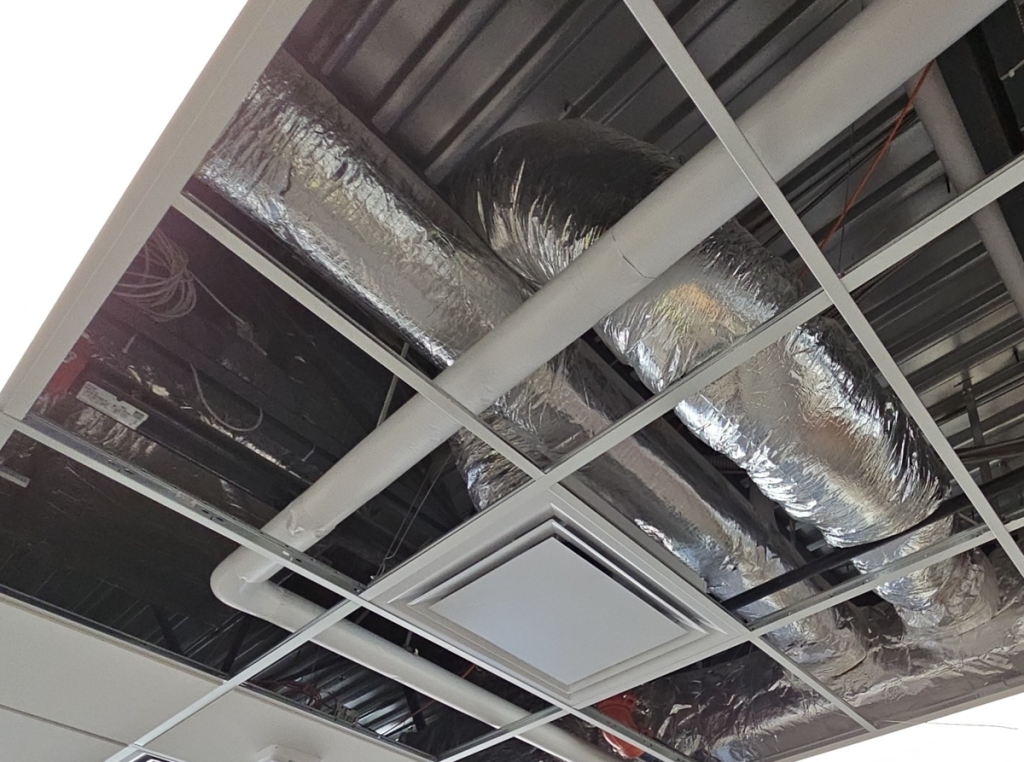
Here’s a real one. This flex is probably 10 feet long. It goes over another duct and back down to the register, a 180-degree bend, and it’s so long it’s lying on the ceiling grid. The ends are taped, so somebody cared about the connection and not the run.
The fix is to come straight up off the register with hard pipe, put a 90 on it pointing toward the take-off, and then run a short, angled piece of flex between the take-off and the elbow.
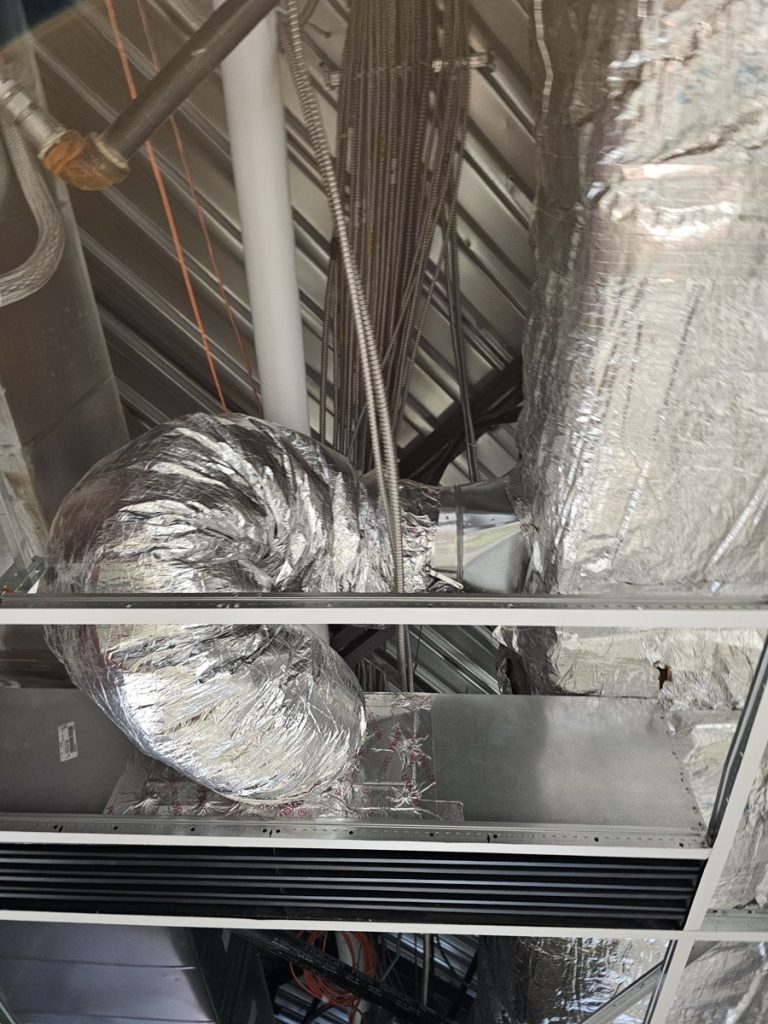
This one has the same problem in a much shorter run. The flex is making a 180 degree bend to reach the box grille. The fix is to put a 90-degree elbow on the grille pointing up, then flex from the take-off to the elbow.
A hard 90 moves air better than over-stretched, kinked flex. Don’t make the flex do the turning.
Hanging and supporting flex
If you follow SMACNA on a commercial job, those short runs usually don’t need support. The run is short and a gradual 90 or less, and it just connects the ceiling device to the take-off.
In an attic, flex lays on the insulation or runs through the trusses. Stay out of the center walking path of the truss space, because the homeowner and every service tech after you will need to get through there.
Dryer vents and exhaust fans can lay on the ceiling or insulation and weave around obstructions. Dryer vents have limits on how far they can run and bend, so check them. This duct is flimsy and tears if it snags on something, so map your route with intent before you pull it.
How to connect flex duct to a collar
Round duct gets wrapped in insulation, and the wrap is taped at the end to hide the fibers. The flex inner sleeve butts up to that tape. Then the flex insulation gets pulled up to the duct insulation, and the plastic outer jacket is tucked under the insulation.
Tighten it down with a band or zip tie using banders. Done right, the end looks like the hem on the bottom of a pair of jeans. If insulation is hanging out the end of the flex or out of the duct wrap, that’s a poor install.
No banders? Lineman’s pliers will work, but they won’t get the zip tie as tight. If you use a metal band clamp, tighten it with a screwdriver or a drill.
Zip ties and cold weather
For a long time I used heavy-duty zip ties without thinking about it. Then I learned what cold does to them. Zip ties that freeze and thaw get brittle and snap when you tighten them.
In an attic, I’d recommend steel band clamps, because they won’t break from freezing. I’ve honestly never seen a contractor use them, but they hold. A commercial ceiling cavity probably won’t freeze, so the real risk there is the truck. A couple of really cold days with a bag of zip ties riding around, and they’re no good.
Proper flex duct installation gets tested
On commercial work, everything gets tested and balanced. If a register isn’t getting its air, somebody gets a call to fix it. If the flex isn’t within the standard, the owner doesn’t pay for that fix. You do.
In a house there’s no balancer (unless the owner pays for one), so use common sense. If the flex is pinched or kinked, it isn’t going to work well, and it will most likely turn into a callback.
Flex duct installation questions
What is the maximum length of a flex duct run?
On commercial work, the SMACNA standards and the project’s install detail set it. One recent job of mine capped it at 4 feet, with no bend over 90 degrees. Check your drawings, because the detail on your job is the one that counts.
Can flex duct make a U-turn?
No. A 180-degree bend isn’t allowed. Use a hard elbow to make most of the turn if the flex will bend more than 90 degrees. Hard elbows can be used to align the register to the duct path to help keep it straighter.
Does flex duct need to be supported?
Short commercial runs that meet SMACNA usually don’t. Longer runs and attic runs need to lie flat or be supported so they stay inside sag criteria.
Can you use flex duct in an exposed ceiling?
No. If the duct is going to be seen, it’s hard pipe. Might even be sweeping elbows.
What should I use to clamp flex duct?
Zip ties tightened with banders are the most common. In an attic or anywhere cold, steel band clamps won’t snap the way frozen zip ties do.