If you’re weighing the HVAC career pros and cons, here is how it looked from inside the trade. Installing duct, furnaces, air conditioning systems, and controls is a rewarding skill. What you learn, you will never forget. Sharing what you learn and bringing others up is a rewarding part of the work too. The work is not always glamorous, but it is challenging and rewarding.
If you want the short version of what this job is, start with what a tinner does.
HVAC Career Pros
- Staying fit.
- Working with a great group of people and building a teamwork environment.
- Travel perks and getting to experience other areas of the country.
- A wide variety of skills to learn.
When I started in HVAC, I had held full-time jobs before, but this was different. It was my first job as an adult on my own, in a different place away from my family, and I had to make it work to support myself. My mindset was to look forward.
I will never forget a small job in Hawaii. We were there for a week and only had three days’ worth of work. I was dreading not getting a full 40 hours. My boss said he would pay me full wages, and we had a lot of fun playing at the beach. It was the most fun money I have ever made.
In my experience, work runs in cycles. We had a lot of cutbacks in 2010, when the economic crisis finally caught up to our backlog. The team got smaller and smaller as the projects dried up. That was a unique time in history. Outside of that, I have seen work available all year long. If your company is not getting jobs, that is most likely an estimating problem. There are plenty of companies working on other projects.
HVAC Career Cons
- Improper lifting can result in back pain.
- The repetitive cutting motion can cause pain in the wrist.
- With a family, traveling can get tiring.
Lift improperly for several years, like I did, and you get a bulging disc on your L5-S1.
The only way I was able to make my wrist pain go away was to take a week off and let my hand heal. When I came back, all the tendons, muscles, and ligaments were rested and ready. I never had pain in my wrist again while installing.
With a family, traveling can get tiring and undesirable. I have worked in Idaho, Utah, Arizona, Wyoming, Texas, Hawaii, and California. When I was single, it was fun to spend time with my coworkers and be on the road. Being gone for a week at a time, every other week or once a month, was a fun way to get away. Once I was married and we started our family, that allure quickly wore off. We were never gone long enough for all of us to go. And what would my wife do while I was working all day, hang out in a hotel with a kid?
The hottest attic I have ever worked in was in Wendover, Nevada. It was my first day on the job, and everyone was surprised I came back the next day. The coldest crawlspace I have ever worked in was in Morgan, Utah. Just thinking about it brings back the chill. The coldest I have ever been was running gas line on a roof in Idaho in a snowstorm. The job is where the job is.
Don’t Let the Cons Scare You
Installing HVAC has several roads to take. There will be cold days, hot days, and long days. The skill of doing it and what you learn are irreplaceable.
What an HVAC Career Costs to Start and What It Pays
There is a cost to becoming an HVAC installer. Every installer needs their own tools. Borrowing will work for a day or two, but the person you borrow from probably only has one of that tool. Letting a new guy use an experienced person’s tools is not time efficient.
I have shared this elsewhere on the site, but the first tool I bought was a duct board knife. I bought one or two tools a week until I had a basic set. The big purchases were the drill, offset hand seamers, and tool belt. Most tools are small dollars. A $10 11-in-1 screwdriver or a $15 pair of snips is an easy amount to spend once a week. The bigger-dollar items I had to budget for. Here is what to buy first as a sheet metal apprentice.
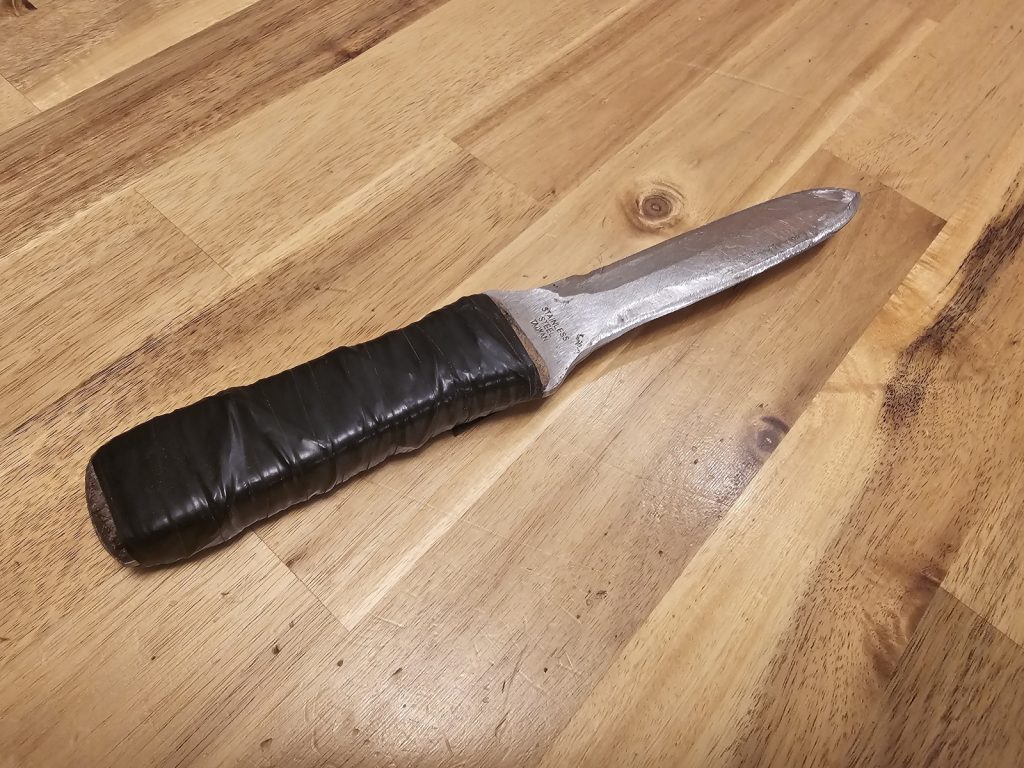
Once you get past the cost barrier, and that might take a couple of paychecks to afford a drill if you are starting with limited cash, you should be in a good place to learn a variety of work.
If you are new to the trade, maybe in trade school or registered but not started yet, the starting wage is low, maybe $15 to $20 an hour. At $15 an hour, that is about $31k a year. I think In-N-Out pays roughly the same. Experienced guys three to five years in can make over $75k a year. That isn’t “I have been doing this for three years, so I now get this much.” That is putting in the work to get new skills, stepping up on the team, and showing that you are competent. (These are 2026 dollars. I have never worked for a union shop. My pay scale experience is based on non-union work and the values I put in this post are not a guarantee.)
It is naive to think that once you learn how to connect duct, you have mastered hanging duct. Have you learned how to lay out the duct? Where to find the spacing dimensions for straps? Have you remembered to add an inch every time you cut an offset? Probably not. You will get there.
Where an HVAC Career Can Take You
The part I love most is all the avenues this field can take you down. Most people start out wrapping insulation, applying mastic as duct seal, or packing material where it needs to go. That is the first month. From there, you volunteer to help the controls guy wire up furnaces. Or you get asked to help the condensate guy put drains on rooftop units. Or you help the line set guy connect an AC, and stare at a vacuum pump pulling air out of the system for an hour.
The path I was headed down was controls and startup. The trade can take you into the shop as a fabricator, learning to program a plasma cutter and leading production of material for onsite install. You can become a service technician for many different types of systems. You can get into the wet side and do boiler systems or radiant heating, cooling towers, venting and exhaust systems, or BMS systems. There are so many fields to go into once you start. A lot of that comes down to the company you start with, because not all companies do every type of system.
The trade may even take you into the office, doing quantity takeoffs and estimating. There is potential to meet with clients and give in-home estimates all day. And you can run your own business once you get enough skill under your belt.
Training Yourself
It is easy for me to sit at this keyboard and say, “You will get there.” I have already been there, and I know there are certain steps to take to get there.
- Show up every day.
- Take part in the hard tasks that others don’t want to do.
- Volunteer to go out on service calls as a helper with a more experienced employee.
- Take the lead and own the tasks the foreman gives you.
- Ask for a raise once you have a basic understanding of how to do new tasks. You will get a quiz if you do this, so be prepared.
The questions will be things like these. What have you learned about [fill in the blank] that prompted this? What do you look for to avoid [a common mistake]? Who have you worked with that can vouch for you? What compensation are you expecting?
You are going to make mistakes along the way, and that is okay. It is expected. If you mess up on everything, you will most likely be the first to go in a downsizing. If you treat mistakes as lessons learned and improve, that is what is expected and wanted. Fewer mistakes mean more efficiency. More efficiency means more work done in a shift, and that helps everybody.
Training Others
When you train someone, don’t be afraid to give them all the tips, all the tricks, and all the shortcuts. Help them get efficient as fast as possible. They might pass you and teach you something, and that is okay. The work is about the team and completing the project together.
When I started in HVAC, I had a little experience doing odds-and-ends fixes around the house, working on my grandpa’s farm in the summer, and helping my uncle on some projects. All I had was a good attitude, and even that was met with skepticism. I had to prove to my boss that I was willing to learn and do the job, no matter where it was. After three years, I had gotten a 90% pay increase. I had not really outpaced anyone. People came and went. I just stuck around, did the work every day, wanted to do new things, and I got those opportunities.
My best on-the-job mentor was a guy I will Call Jerry. He was just a cool guy who really enjoyed doing the work, and he would push me beyond my basic understanding so he could rely on me. One day he handed me a spray bottle and said, “Go find the leak” on a condenser line. So I started at joint number one and went to the next joint on the line, over and over.
This was a potato warehouse in Idaho, bigger than the state of Texas. After about two hours of spraying joints, I found a leak on an existing elbow, and it was a pretty bad one. I went to tell him I found the leak. He said that was impossible, so I showed him. It was about a 15-minute walk to get there. As we stood there, he sprayed it to make sure he saw the bubbles, looked at me, and said, “Go get the torches.” I didn’t need any praise. His stunned face was thank you enough. He had literally been chasing pressure issues on that system for three days and couldn’t get the system to work right with the pressure loss on the test cycles. We got it fixed, and the system worked. Now that I think about it, I never did check the rest of the line.
When someone is ready to work alone on something, they prove it to you by catching a mistake, either one they made or one someone else made. They are proving to themselves that they understand the issue and know the solution. Sure, they might come and ask for help on a nuance they have not run into yet. For the most part, people want to get to the next step.
Is an HVAC Career Worth It?
I say yes. The skills gained from doing any trade make you marketable to anyone who knows nothing about it, can’t figure it out from binge watching YouTube videos or wants to pay someone else to fix their problem. If you have a passion to be in the field on your feet and staying active, this is a great avenue. You will learn something new often and what you learn, you will never forget.
Just starting out? Check out this resource for tools you need.